
Habitat gallery
Explore shared photos or design concepts for inspiration.
Customer-shared photos
These are AI-generated design studies. Each includes a separately credited photographic reference.
Aquarium design & setup
Here are a few ideas for freshwater tank styles and themes.
Terrarium design & setup
A few terrarium ideas, from a dry hillside to a mossy forest floor.
Paludarium design & setup
A paludarium combines land and water in one enclosure. Getting both sides right takes extra planning, but it opens up some interesting possibilities for what can live along the water’s edge.
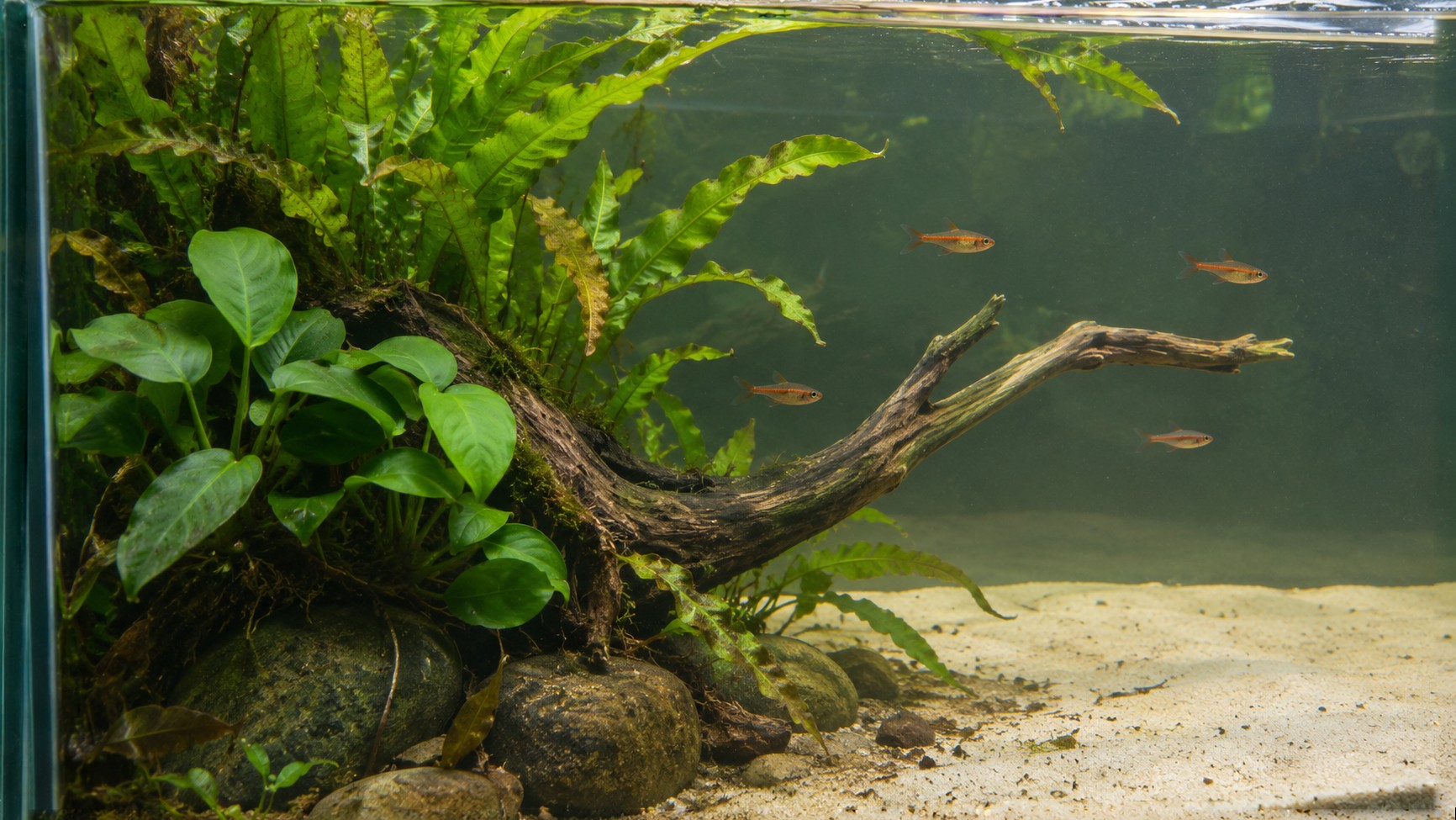
A branching root anchors a deep planted bank, with a broad swimming lane above the wood.
Plant ideas
- Java fern (Microsorum pteropus ‘Trident’) fans out from forks in the wood.
- Dwarf anubias (Anubias barteri var. nana) clings low on a root.
- Wendt’s crypt (Cryptocoryne wendtii) fills substrate pockets at the base.
- Dwarf hairgrass (Eleocharis pusilla ‘Mini’) softens the front edge.
Fish ideas
- Ember tetras (Hyphessobrycon amandae) form a small, copper-colored shoal near cover.
- Harlequin rasboras (Trigonostigma heteromorpha) use the open lane beside the roots.
Choose a shoal around the available swimming length. Keep fern and anubias rhizomes above the substrate.
Upkeep
Thin the fern leaves and keep the open sand accessible for cleaning.
Plant and animal references
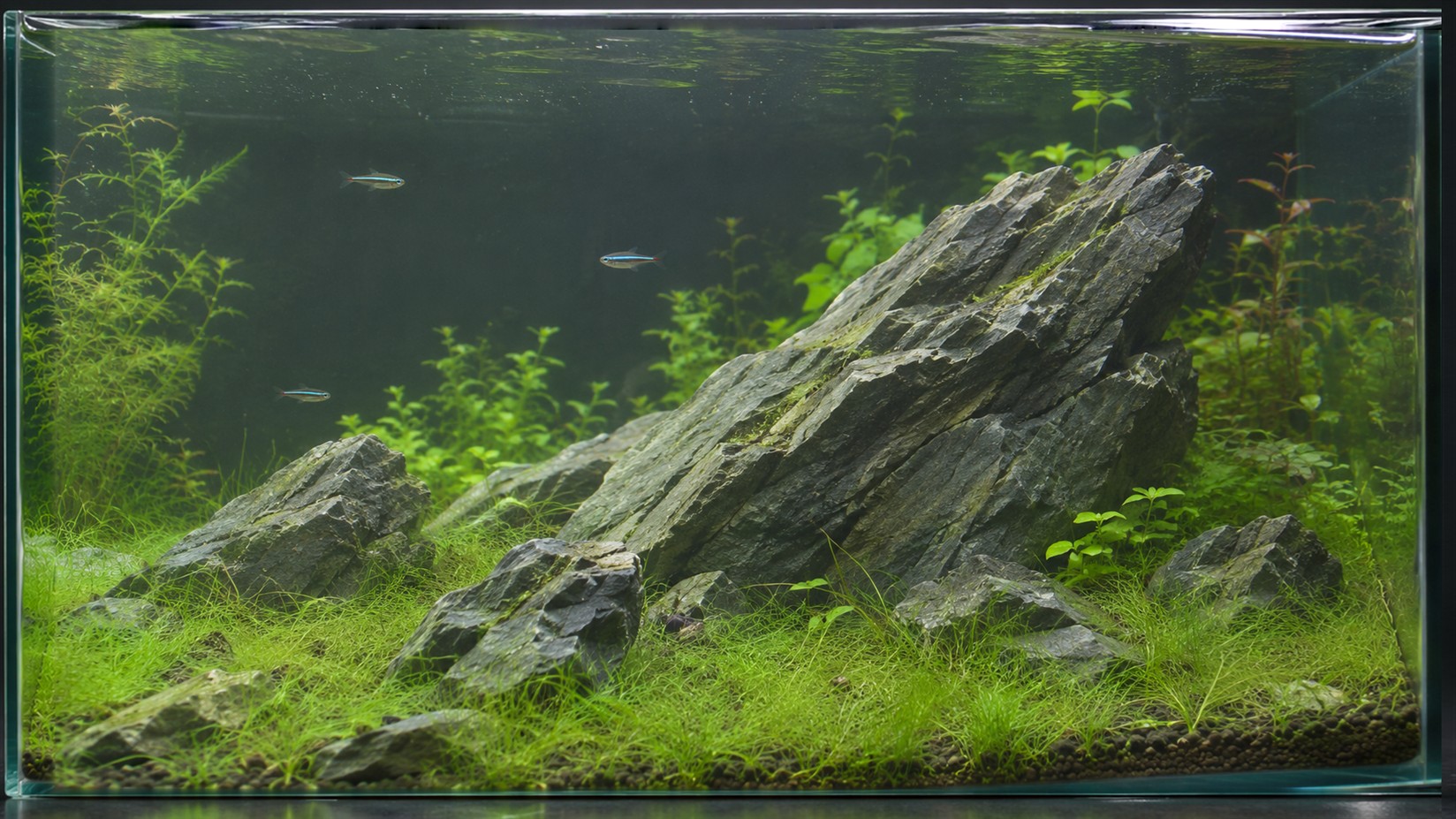
A ridge of stone breaks through a low carpet of plants, leaving clear water overhead.
Plant ideas
- Dwarf hairgrass (Eleocharis pusilla ‘Mini’) forms a fine foreground.
- Water clover (Marsilea hirsuta) makes low patches between stones.
- Staurogyne repens creates short leafy tufts at rock bases.
- Trident Java fern (Microsorum pteropus ‘Trident’) provides cover behind the tallest stone.
Fish ideas
- Harlequin rasboras (Trigonostigma heteromorpha) suit an open lane with planted refuge.
- Ember tetras (Hyphessobrycon amandae) suit a quieter layout with more sheltered edges.
Leave a planted retreat behind the ridge. Check whether the chosen stone changes hardness before selecting fish.
Upkeep
Trim the foreground and brush exposed rocks as needed.
Plant and animal references
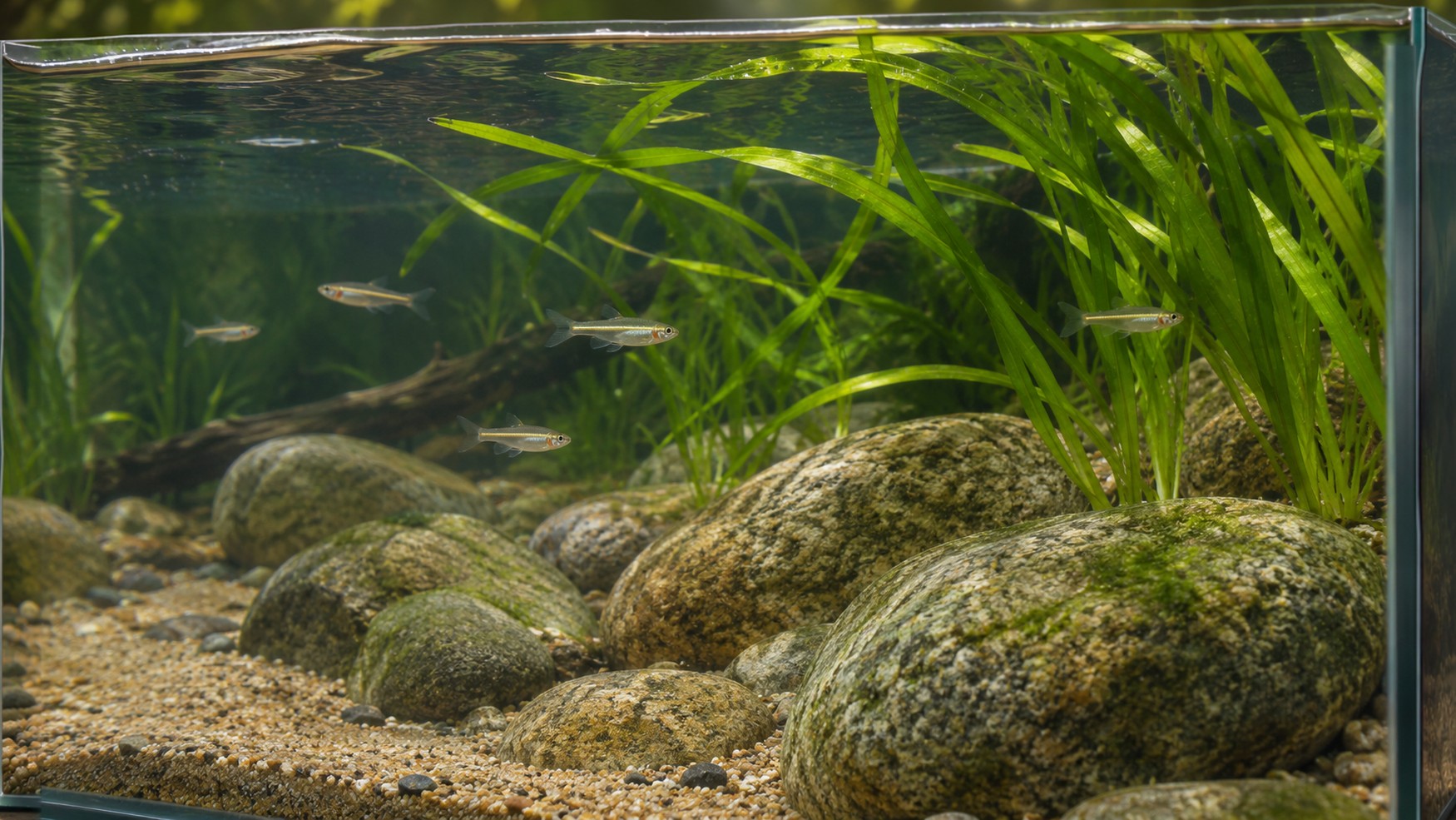
Smooth cobbles and broad stretches of pale sand trace a streambed through a long aquarium.
Plant ideas
- Tiger tape grass (Vallisneria spiralis ‘Tiger’) trails in the current at the back.
- Narrow Java fern (Microsorum pteropus ‘Narrow’) anchors to shaded cobbles.
- Beckett’s crypt (Cryptocoryne beckettii ‘Petchii’) roots in sheltered gravel pockets.
- Staurogyne repens fills a low bank away from the main current.
Fish ideas
- White cloud mountain minnows (Tanichthys albonubes) suit a cool, well-oxygenated shoal tank.
- Fireline danios (Devario sondhii) are an alternative for a long, covered temperate tank with flow.
Provide calm pockets behind stones as well as moving water. Match the temperature to the chosen fish and planting.
Upkeep
Check for trapped debris behind cobbles and keep the current moving through open channels.
Plant and animal references
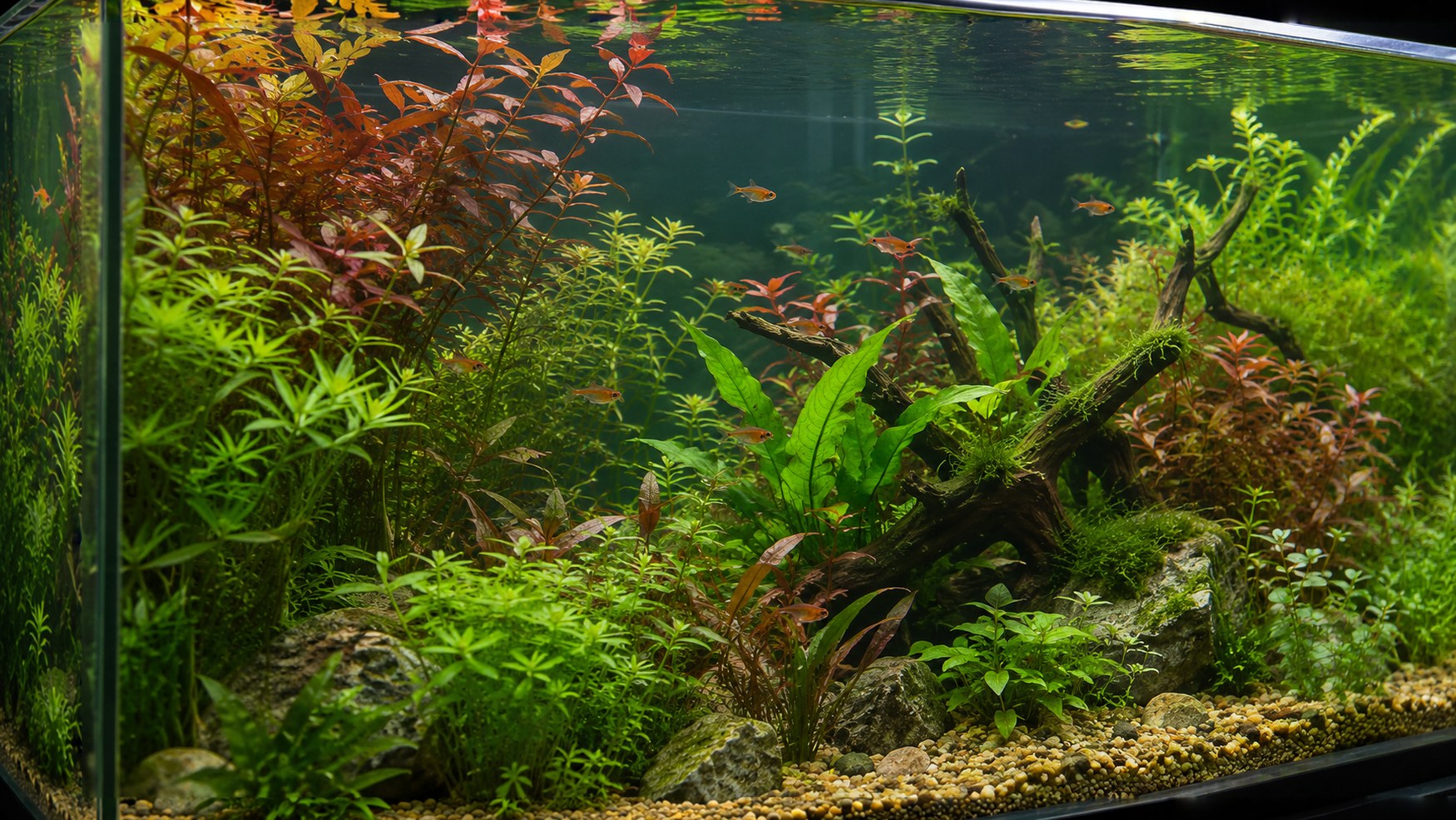
Groups of stems in different heights and colors form sweeping beds beneath an open band of water.
Plant ideas
- Wallich’s rotala (Rotala wallichii) forms a fine-textured rear planting in strong light.
- Red ludwigia (Ludwigia repens ‘Rubin’) creates a copper-red accent.
- Lemon bacopa (Bacopa caroliniana) adds a contrasting bank of rounded leaves.
- Downoi (Pogostemon helferi) makes low, ruffled clumps along the foreground.
Fish ideas
- Cardinal tetras (Paracheirodon axelrodi) suit a warm, mature aquarium with room to shoal.
- Cherry barbs (Puntius titteya) use the sheltered margins of planted beds.
Choose the group for the water conditions. Replant stem tips to keep the lower leaves in light.
Upkeep
Thin and replant tall stems regularly so the shorter plants still receive light.
Plant and animal references
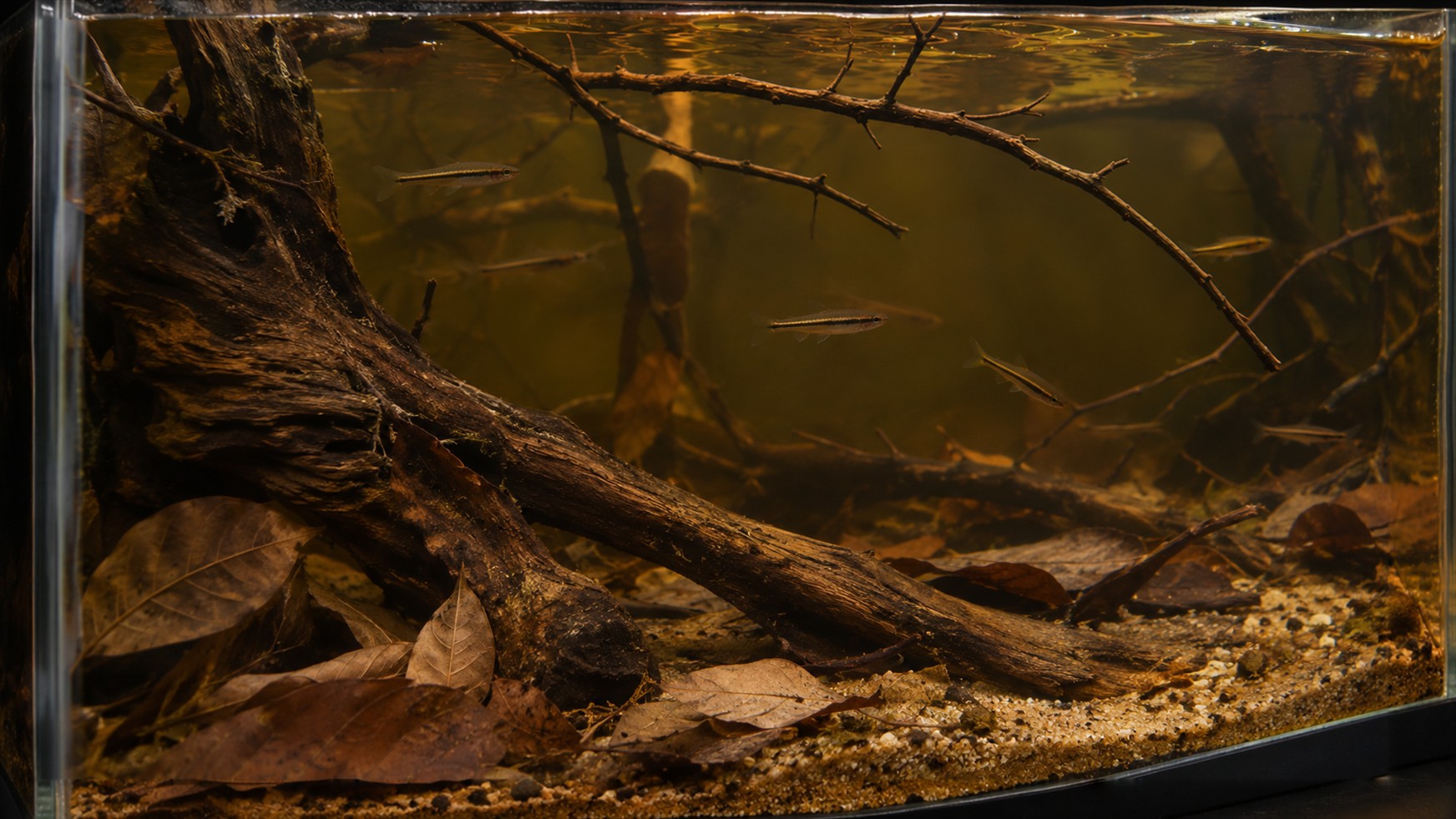
Bare branches reach through amber water. Fallen leaves settle on the bottom between the roots.
Plant ideas
- Dwarf anubias (Anubias barteri var. nana) on a low branch.
- Trident Java fern (Microsorum pteropus ‘Trident’) on the brighter edge.
- Bucephalandra pygmaea ‘Bukit Kelam’ in a shaded wood crevice.
- Wendt’s crypt (Cryptocoryne wendtii) in a rooted pocket where light reaches the bed.
Fish ideas
- Cardinal tetras (Paracheirodon axelrodi) are an option for a warm, stable, soft-water setup.
- Black neon tetras (Hyphessobrycon herbertaxelrodi) shoal above wood and leaf litter.
Use sparse planting and a clear swimming channel. The plant palette evokes blackwater scenery across regions.
Upkeep
Monitor water conditions and replenish leaf litter gradually as it breaks down.
Plant and animal references
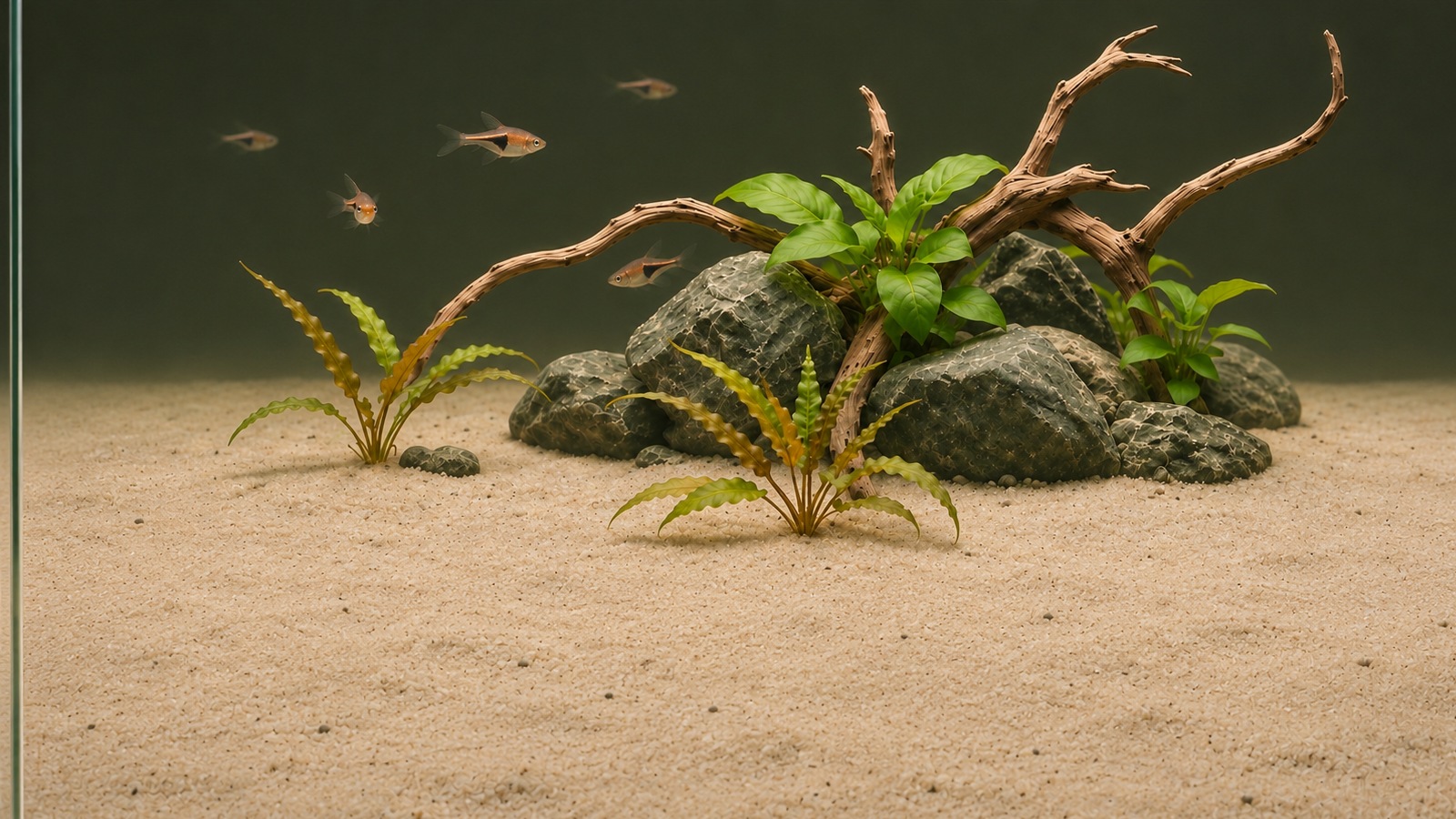
An island of dark stone, driftwood and leafy plants rises from a broad stretch of pale sand. Small fish swim in the open water around it.
Plant ideas
- Dwarf anubias (Anubias barteri var. nana) caps the center of the island.
- Java fern (Microsorum pteropus ‘Trident’) adds height over the wood.
- Wendt’s crypt (Cryptocoryne wendtii) anchors the planted mound.
- Dwarf hairgrass (Eleocharis pusilla ‘Mini’) marks the transition into bare sand.
Fish ideas
- Harlequin rasboras (Trigonostigma heteromorpha) use open water around the island.
- Black neon tetras (Hyphessobrycon herbertaxelrodi) suit a long display with wood and planted cover.
Keep most of the sand open and one face of the island dense enough to shelter a shoal.
Upkeep
Trim the edges of the island and lightly clean the exposed sand.
Plant and animal references
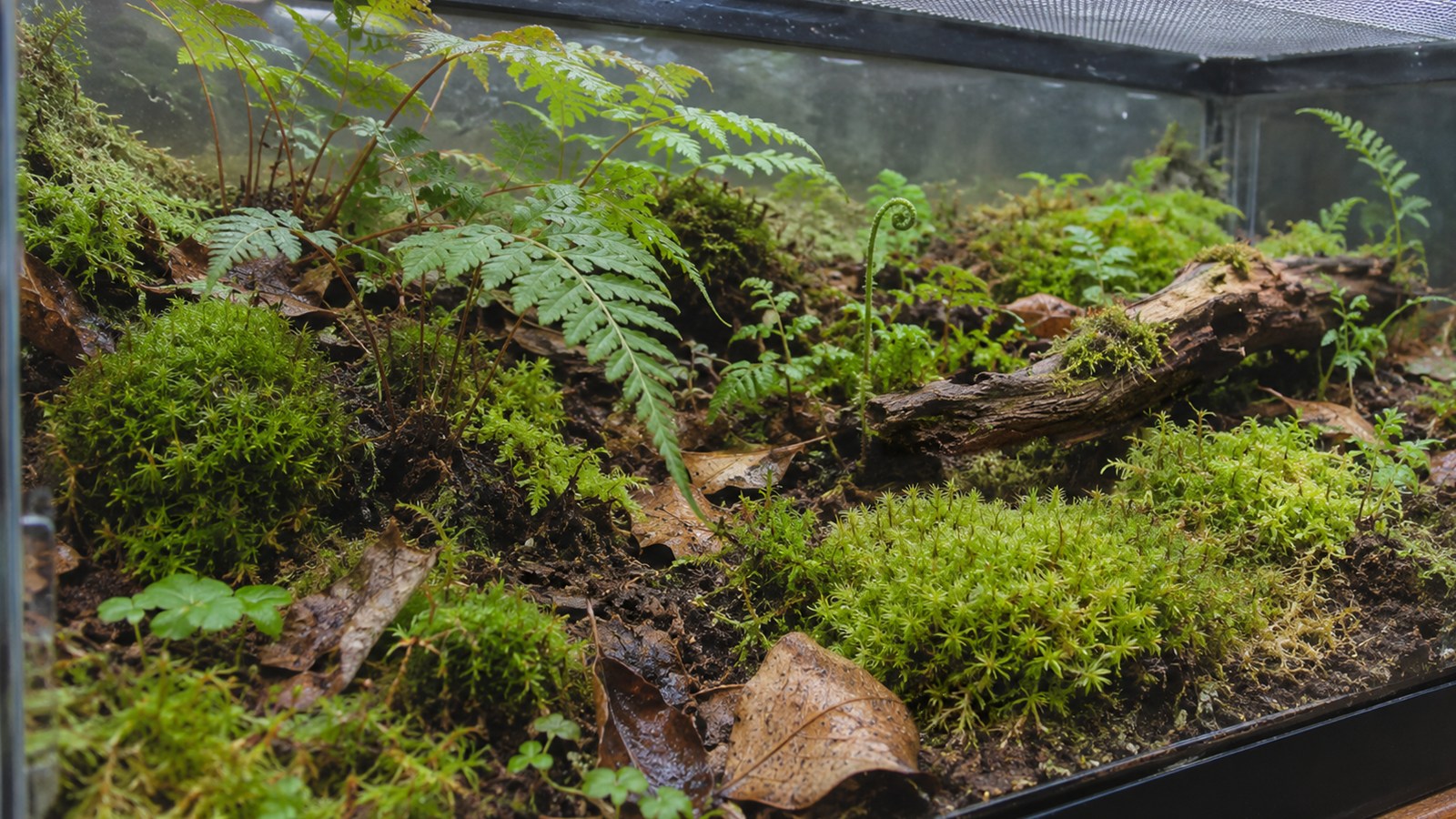
A woodland floor extends across a wide enclosure. Moss gathers around fallen wood with low ferns growing in the gaps.
Plant ideas
- Pincushion moss (Leucobryum glaucum) builds rounded mounds along a raised bank.
- Broom moss (Dicranum scoparium) adds upright tufts on drained, shaded humus.
- Delicate fern moss (Thuidium delicatulum) traces the lower woodland floor.
- Korean rock fern (Polystichum tsus-simense) gives height behind the log.
Animal options
- Plant-focused woodland display.
- Temperate white springtails (Folsomia candida) are an optional detritivore in moist leaf litter.
Use cultivated moss and leave space between patches. Match the fern and mosses to a cool, ventilated planting rather than sealing them in stagnant heat.
Upkeep
Check moisture across the enclosure and lift fallen leaves before they smother the moss.
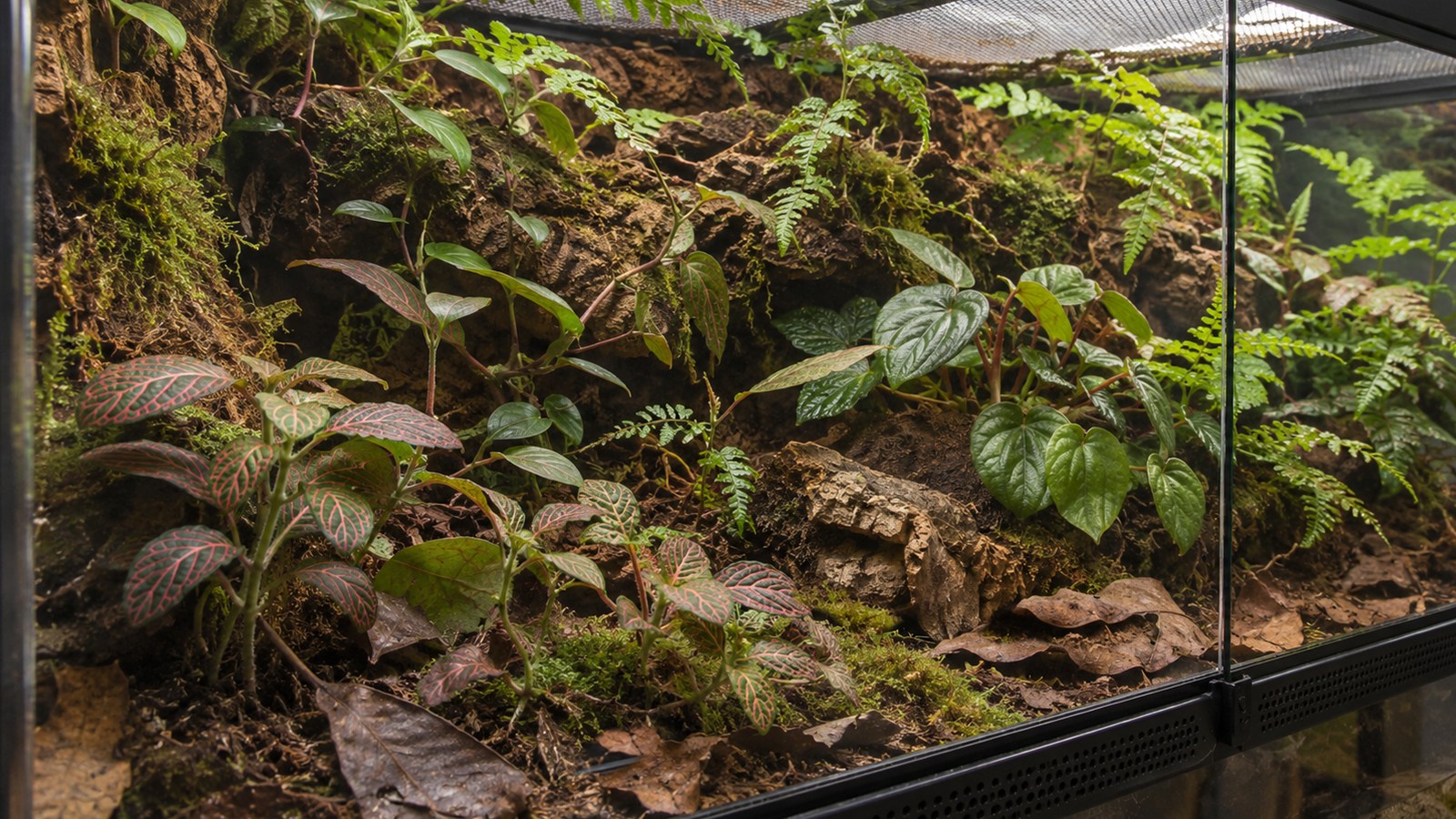
Layered foliage fills a tall enclosure from the leaf litter up, with sheltered planting pockets beneath broad leaves.
Plant ideas
- Nerve plant (Fittonia albivenis) brightens the front with veined leaves.
- Ripple peperomia (Peperomia caperata) fills a sheltered planting pocket.
- Creeping fig (Ficus pumila) climbs a back panel; trim it regularly.
- Bird’s-nest fern (Asplenium nidus ‘Crispy Wave’) forms a larger rosette farther back.
Animal options
- Plant-focused tropical display with optional white springtails (Folsomia candida).
- A captive-bred bumblebee dart frog (Dendrobates leucomelas) is a separate vivarium design with secure cover, ventilation and a leaf-litter floor.
These plants share a humid understory look. A frog-led build needs its own floor area, climate, feeding and escape-proofing plan.
Upkeep
Thin crowded growth and check humidity and ventilation as the canopy fills in.
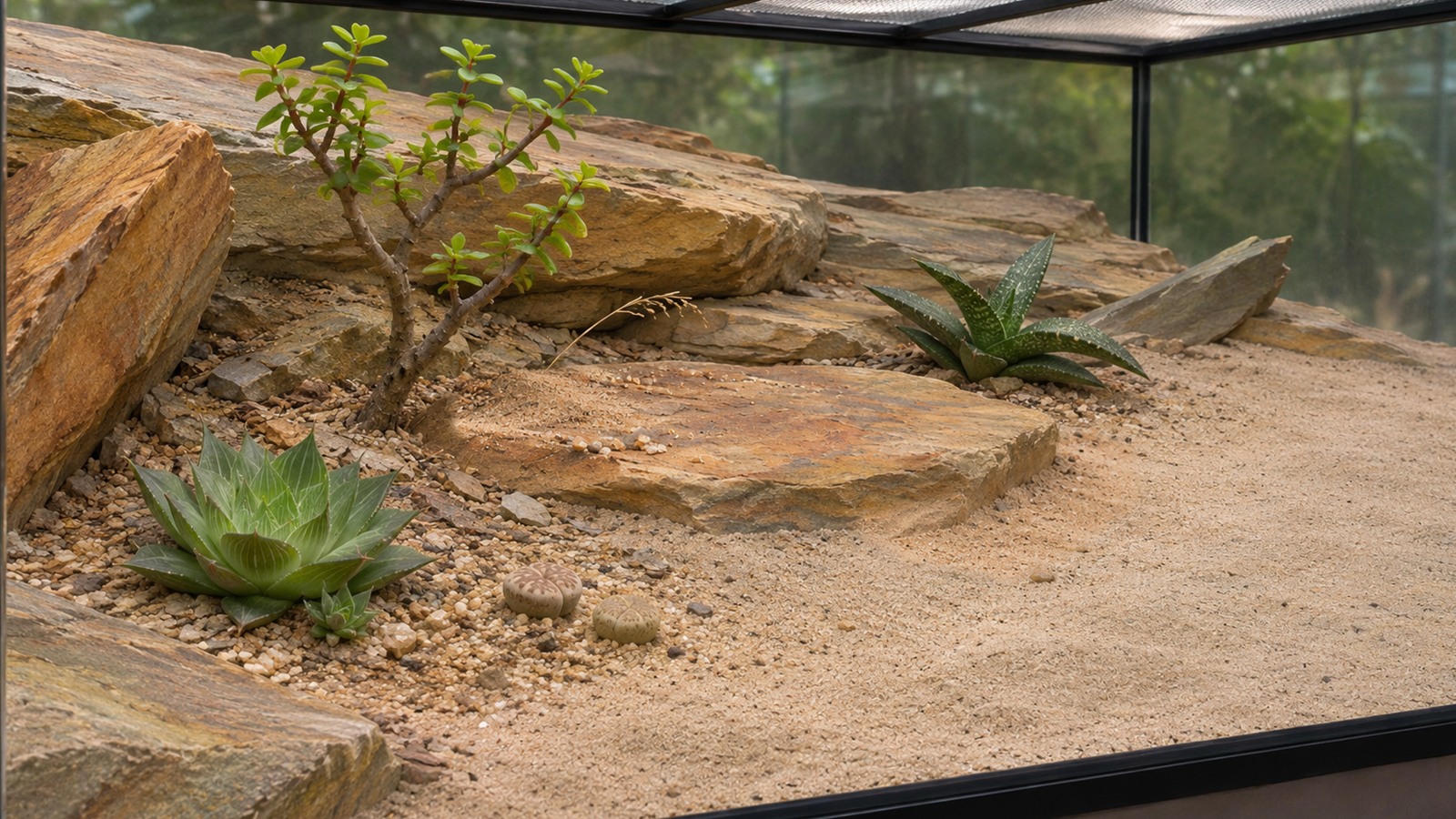
Sand has drifted onto the lower sandstone shelves and lodged in the cracks. Succulents grow in small pockets of gravel between the slabs.
Plant ideas
- Zebra haworthia (Haworthiopsis attenuata) makes a striped rosette beside a ledge.
- Cooper’s haworthia (Haworthia cooperi) adds translucent leaf tips in filtered light.
- Dwarf ox tongue (Gasteria bicolor var. liliputana) nestles in a rocky recess.
- Lace aloe (Aristaloe aristata) gives a raised, brighter pocket a larger focal plant.
- Elephant bush (Portulacaria afra) gives the back ledge a branching silhouette. Prune it to fit.
- Living stones (Lithops spp.) blend into pale gravel. Sink a separate pot so their seasonal watering can be controlled.
Animal options
- Dry planted display as pictured.
- A leopard gecko (Eublepharis macularius) requires a separate pet-led layout with suitable footing, a heat gradient and secure warm, cool and humid hides.
Set root balls into draining mineral mix below the sand dressing. Give the rosettes space and allow planted pockets to dry.
Upkeep
Keep ventilation clear and allow planted pockets to dry between waterings.
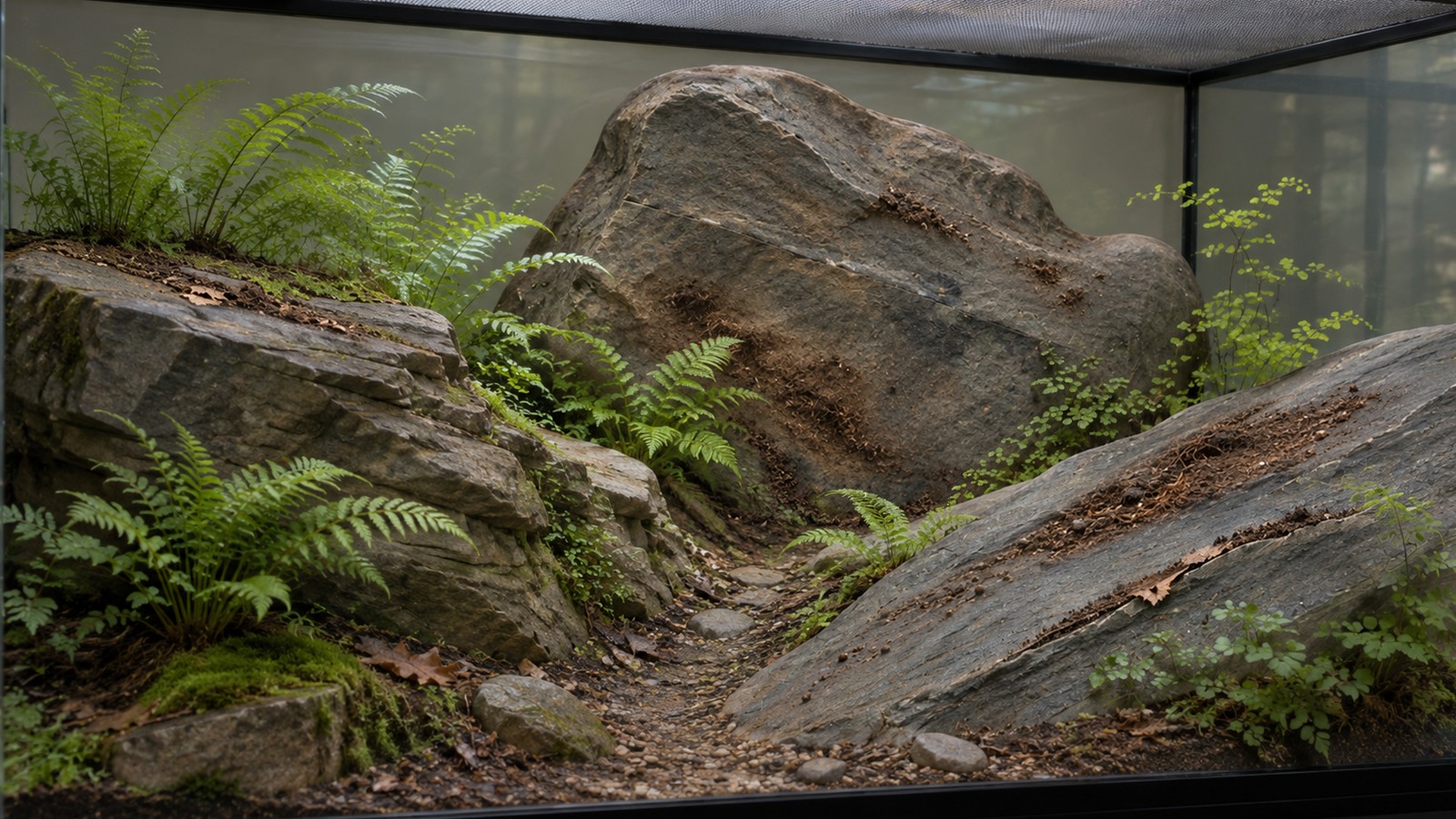
Earth clings to the face of the rear boulder. On the sloping stone at the right, loose grains have slipped downhill from a patch of soil. Ferns line the path between the rocks.
Plant ideas
- Korean rock fern (Polystichum tsus-simense) rises from a deeper shaded cleft.
- Lemon button fern (Nephrolepis cordifolia ‘Duffii’) softens a lower terrace.
- Krauss’s spikemoss (Selaginella kraussiana) trails from moist soil pockets.
- Pincushion moss (Leucobryum glaucum) breaks up a single ledge with rounded green pads.
Animal options
- Plant-focused stone display.
- White springtails (Folsomia candida) can inhabit the damp organic pockets.
Anchor the rockwork independently of the glass. Keep fern roots in planted crevices and leave bare stone visible between them.
Upkeep
Trim fronds away from the passage and maintain even moisture in the planted pockets.
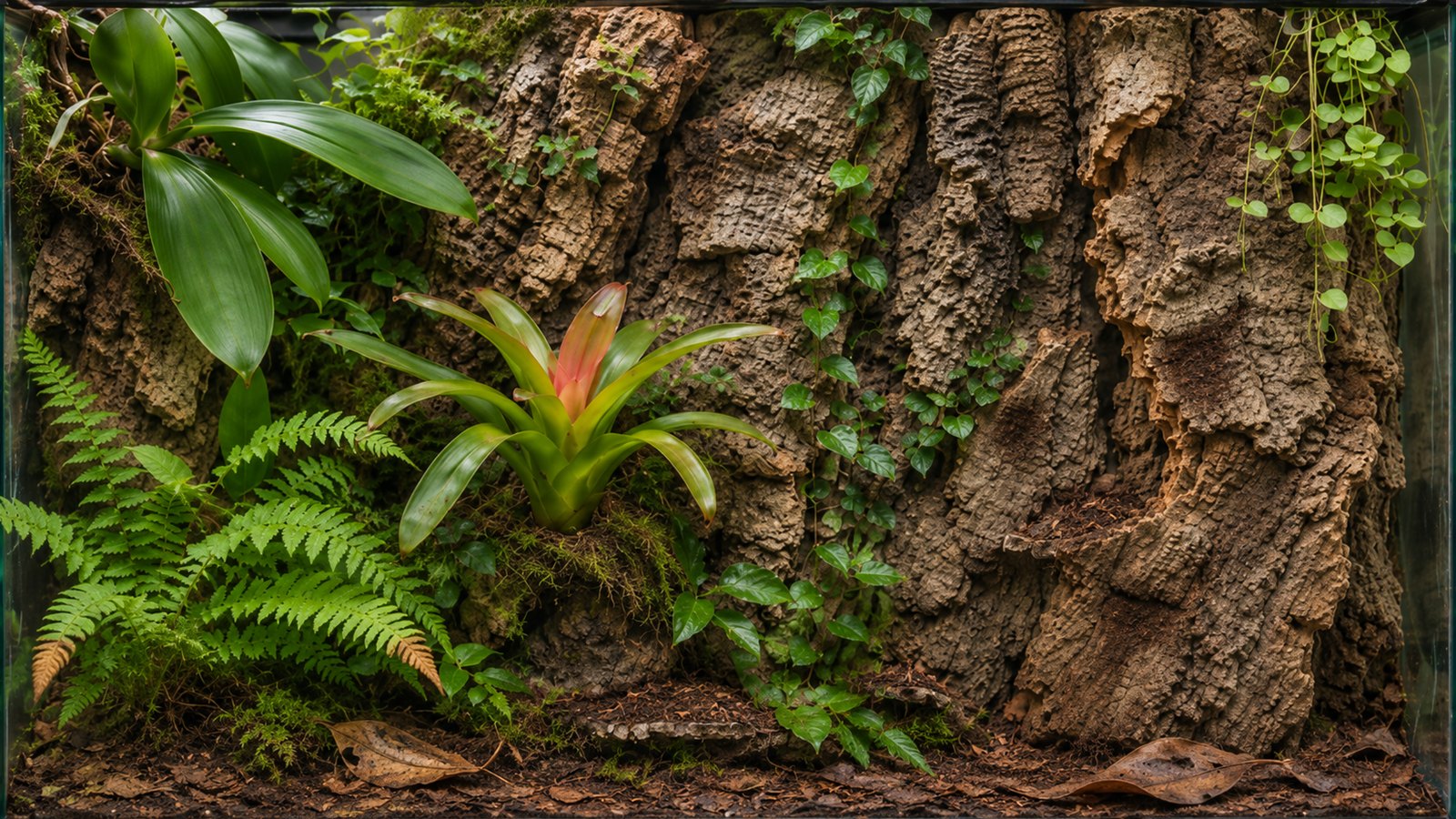
A bromeliad sits in a pocket of ridged cork, beside a climbing vine. Ferns arch over the leaf litter at the base, and crumbs of soil collect on the lower bark.
Plant ideas
- Fireball bromeliad (Neoregelia ‘Fireball’) adds a rosette on a bright upper cork shelf.
- Creeping fig (Ficus pumila) roots along the bark and fills narrow seams.
- Watermelon dischidia (Dischidia ovata) trails from an airy upper mount.
- Equestrian moth orchid (Phalaenopsis equestris) forms an accent on a humid, ventilated mount.
Animal options
- Plant-focused cork wall with optional white springtails (Folsomia candida) in the litter below.
Leave some cork exposed between mounts. Trim fast-growing vines before they cover orchid roots or bromeliad crowns.
Upkeep
Check plant mounts and moisture at several heights. Guide climbing stems before they cover slower-growing plants.
Plant and animal references
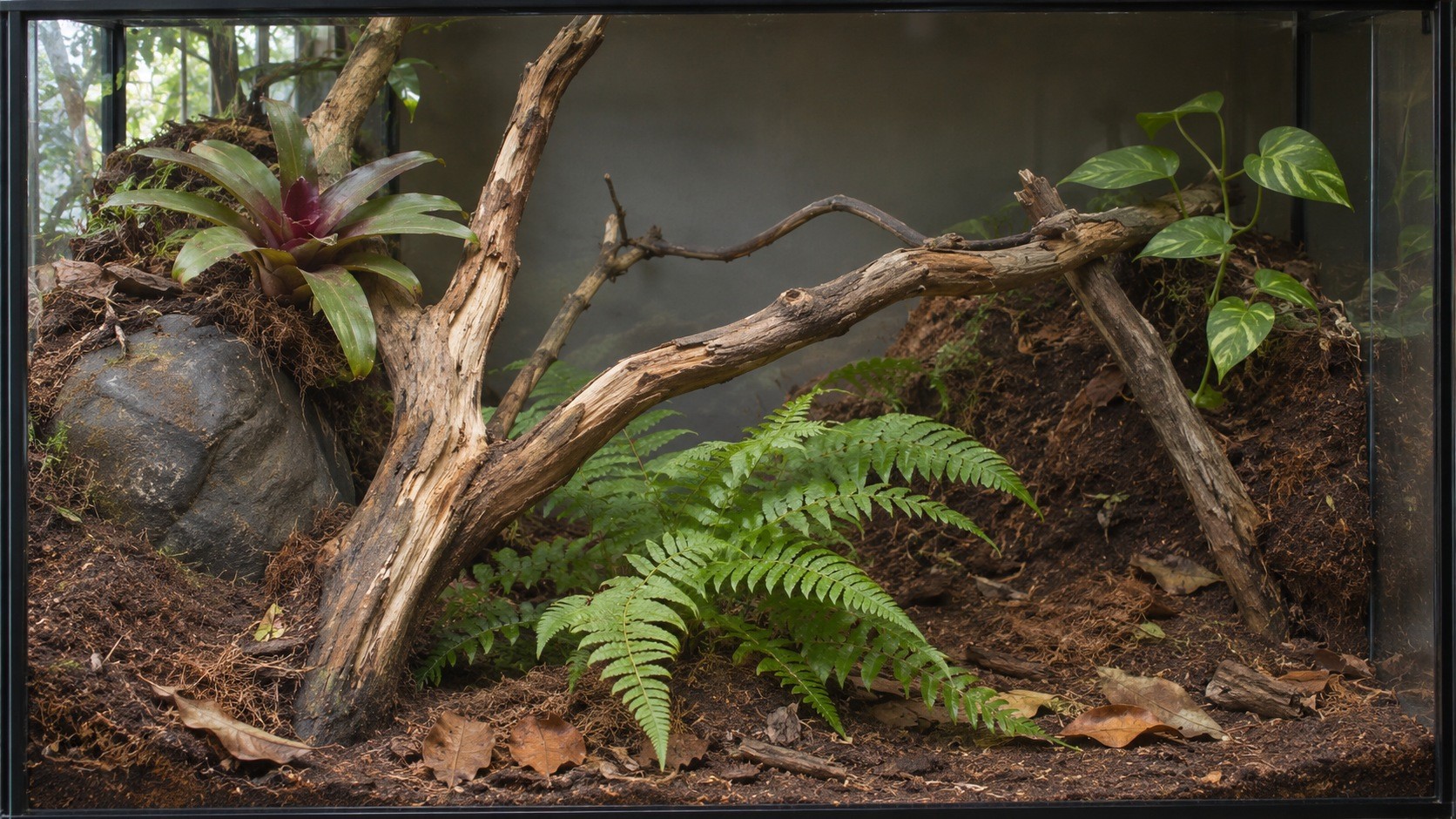
Weathered wood forms a climbing route above the fern. A bromeliad grows from a mossy pocket on one side of the enclosure, and pothos trails from the raised bank on the other.
Plant ideas
- Star orchid (Lepanthopsis astrophora ‘Stalky’) mounts on a sheltered branch.
- Restrepia sanguinea places a small fan of leaves along a humid mount.
- Stelis muscifera adds delicate upright flower spikes on a second branch.
- Korean rock fern (Polystichum tsus-simense) roots in the shaded bank below.
Animal options
- Plant-focused orchid and fern display.
- White springtails (Folsomia candida) can work the damp leaf litter below the mounts.
Choose orchids that share the enclosure’s temperature range. Maintain air movement around roots and leave open spaces between plants.
Upkeep
Balance humidity with air movement and check that mounted roots dry appropriately between waterings.
Plant and animal references
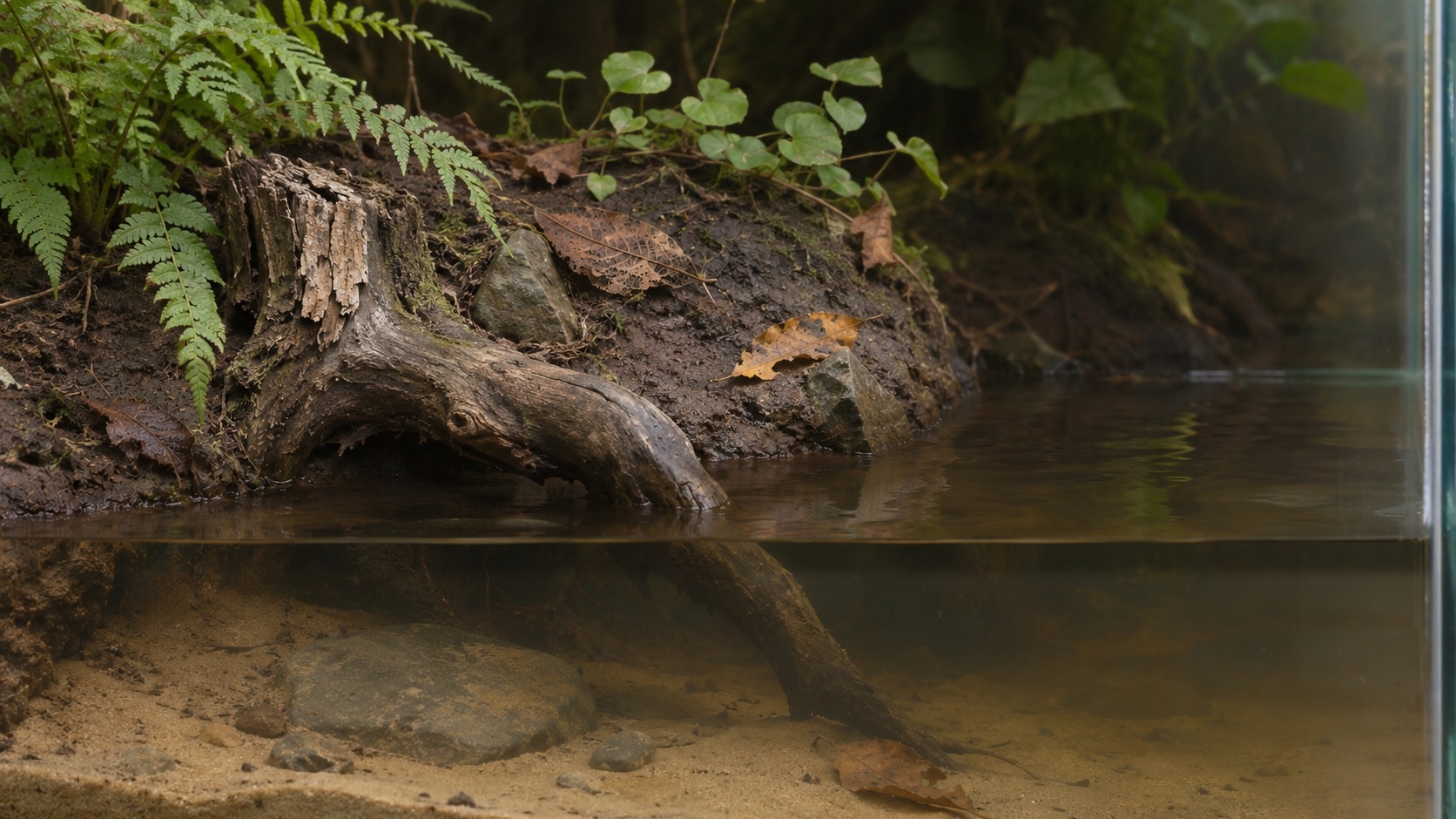
Ferns shade a single weathered root where it curves out of the bank. Below the waterline, its dark tip reaches the sand at the edge of an open pool.
Plant ideas
- Java fern (Microsorum pteropus) — attach it to submerged roots for upright, rippled fronds.
- Dwarf anubias (Anubias barteri var. nana) — tuck its roots into shaded wood crevices and leave the rhizome exposed.
- Java moss (Taxiphyllum barbieri) — grow small patches on submerged root tips so the wood grain stays visible.
- Wendt’s water trumpet (Cryptocoryne wendtii) — plant small groups in sheltered substrate at the foot of the bank.
- Compact Boston fern (Nephrolepis exaltata ‘Fluffy Ruffles’) — give it a moist, draining pocket on the upper bank.
Animal options
- Oriental fire-bellied toad (Bombina orientalis) — redesign the bank with broad resting land, shallow calm water and gently sloping exits.
- Vampire crab (Geosesarma dennerle) — expand the damp burrowing bank to occupy most of the footprint. Give the crab hides, easy routes out of freshwater and an escape-proof lid.
- Copper harlequin rasbora (Trigonostigma espei) — in a fish-focused version, keep a shoal in a mature, gently flowing, soft-water channel with ample swimming length.
Choose one of these animal plans before setting the shoreline. A crab needs much more usable land than a rasbora display. Size the aquatic habitat using the actual water volume.
Upkeep
Keep roots clear of the filter intake and trim the bank before it shades the channel.
Plant and animal references
- Exo Terra · Oriental fire-bellied toad care
- Raffles Bulletin of Zoology · vampire crab ecology
- Herpeton Academy · vampire crab enclosure
- Maidenhead Aquatics · copper harlequin rasbora
- Tropica · ferns, moss and anubias on rock
- Tropica · water trumpet in a planted layout
- NC State Extension · Boston fern cultivars
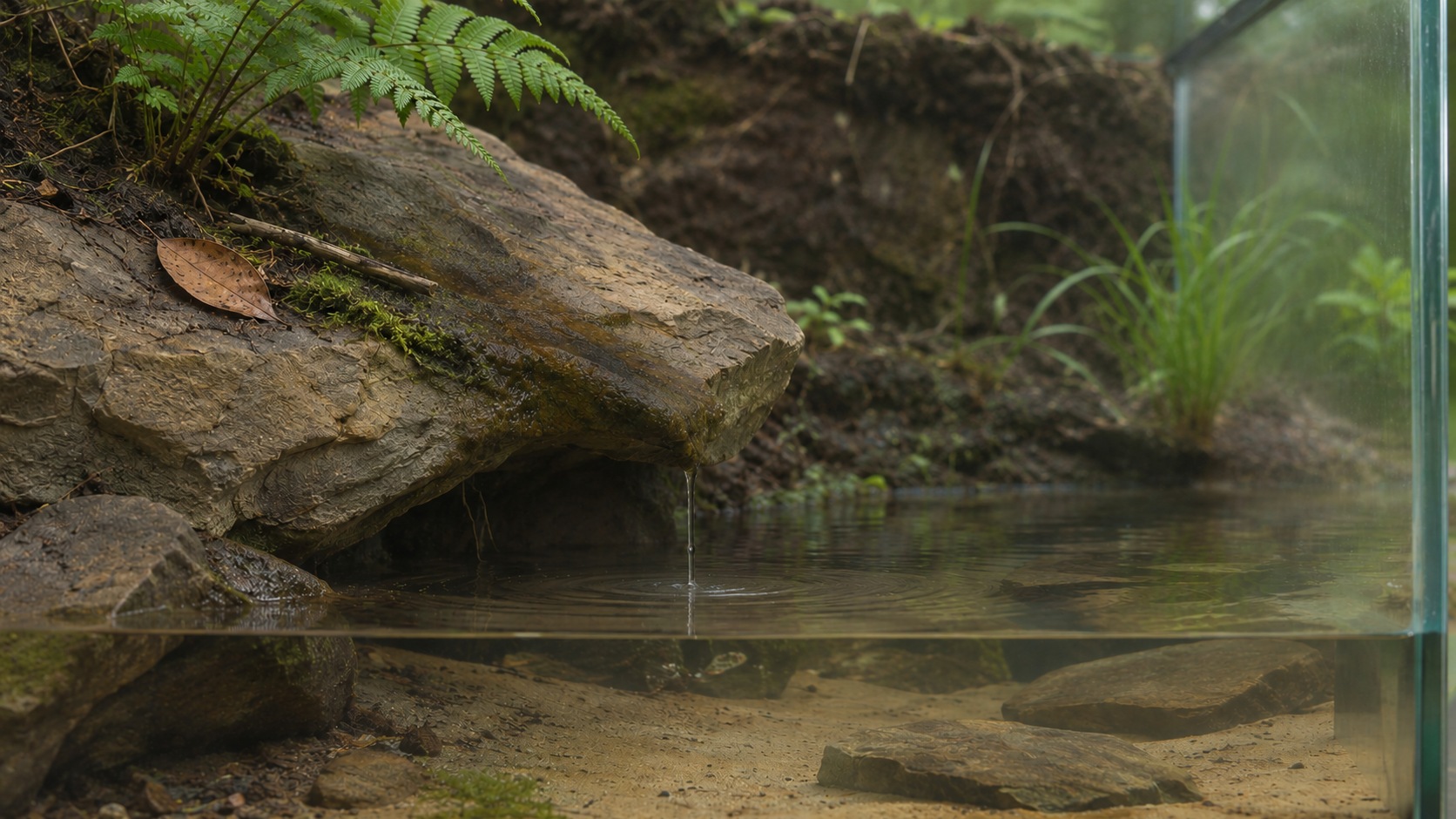
A damp groove carries water across one broad outcrop. A slender trickle drops from the lip into a sandy pool dotted with flat stones.
Plant ideas
- African water fern (Bolbitis heudelotii) — anchor it to submerged stone below the falls, with its rhizome above the gravel.
- Java moss (Taxiphyllum barbieri) — establish low, irregular patches on stones at the wet edge.
- Dwarf anubias (Anubias barteri var. nana) — attach it in the calmer pool beside the falling water.
- Cretan brake fern (Pteris cretica) — plant a few fronds in moist, draining ledge pockets above the splash line.
Animal options
- Vietnamese mossy frog (Theloderma corticale) — this frog uses water-filled crevices beside rocky streams. Provide a cool, tall, enclosed setup with sheltered water, climbing surfaces and accessible perches out of the current.
- Bamboo shrimp (Atyopsis moluccensis) — an aquatic alternative for a substantial, mature pool. Provide a perch in directional flow and fine suspended food for its feeding fans.
- Reticulated hillstream loach (Sewellia lineolata) — a fish-focused redesign needs a long, mature, well-oxygenated stream tank with current across smooth grazing stones. A small waterfall basin is too small.
The frog needs quiet water retreats, while the filter-feeding shrimp and stream fish depend on current in the pool. Choose one plan, then design the flow and screen the pump intake.
Upkeep
Keep the pump intake accessible and check the return path, water level and splash pattern.
Plant and animal references
- Smithsonian’s National Zoo · Vietnamese mossy frog habitat
- Rauhaus and colleagues · mossy frog husbandry
- Aquarium Co-Op · bamboo shrimp feeding
- Fluval · hillstream loach habitat requirements
- Tropica · African water fern placement
- Tropica · Java moss and dwarf anubias
- NC State Extension · brake ferns
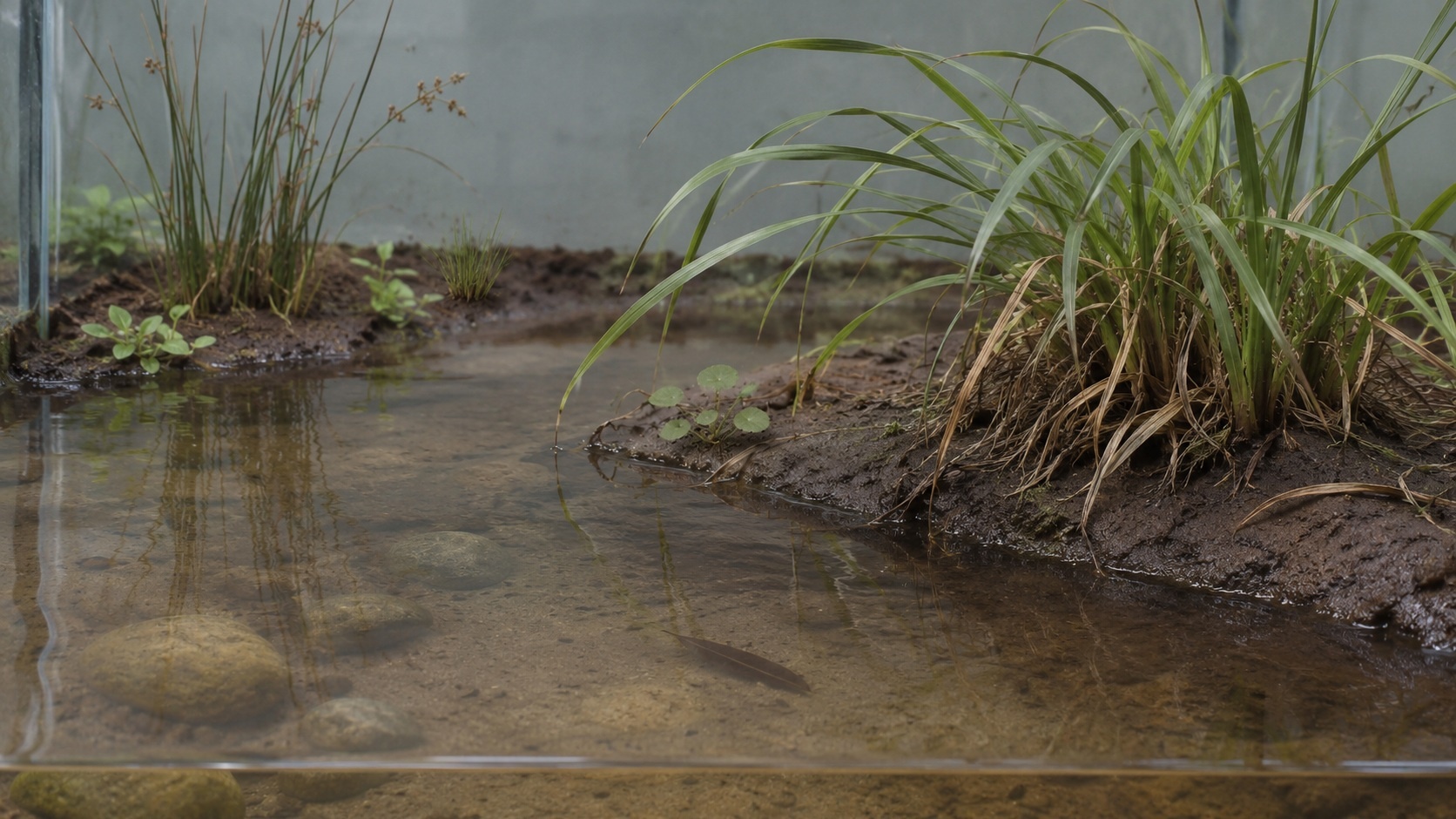
A shallow channel curves around a clump of arching sedge. A small round-leaved plant grows on the muddy point, and a young tuft of rushes fills a gap on the far bank.
Plant ideas
- Lemon bacopa (Bacopa caroliniana) — root stems in the shallows and let some grow above the waterline.
- Creeping rush (Juncus repens) — plant in irregular groups along the submerged shelf for slender green stems.
- Japanese sweet flag (Acorus gramineus) — place the roots in the wet bank with its grasslike foliage in the air.
- Dwarf hairgrass (Eleocharis acicularis) — use small tufts on the submerged foreground to soften the shoreline.
Animal options
- Starry night reed frog (Heterixalus alboguttatus) — raise the enclosure height and add sturdy stems and broad leaf perches over calm water, with easy exits and a secure ventilated lid.
- Spotted blue-eye (Pseudomugil gertrudae) — a fish-only alternative for a mature, covered pool with a gently moving planted margin and a clear swimming lane for its shoal.
- Cherry shrimp (Neocaridina davidi) — an invertebrate alternative for a stable, cycled freshwater pool with grazing surfaces, cover and a sponge-protected intake.
Choose one animal option. The reed frog needs usable height above the marsh. For the fish or shrimp option, plan around the filled pool’s dimensions, filtration and water chemistry.
Upkeep
Thin spreading stems and keep the gently sloping shoreline clear.